If you have been asking yourself how much cosmetology school cost, the honest answer depends on which program you choose and how many training hours it requires.
Choosing between cosmetology and esthetics often comes down to three questions: how long the training takes, what it costs, and where it can lead you.
At Rosel School of Cosmetology in Niles, Illinois, in the greater Chicago metro area, both paths lead to a professional license and job-ready skills, but they differ in program length and investment.
The Esthetics Program is confirmed at $11,000 for 750 hours of hands-on training. Cosmetology follows a longer, state-mandated hour requirement.
This article compares the confirmed cost and length of each program. It also explains how the time-to-license difference can affect your earning timeline, helping Chicago-area students decide which path fits their budget and career goals.
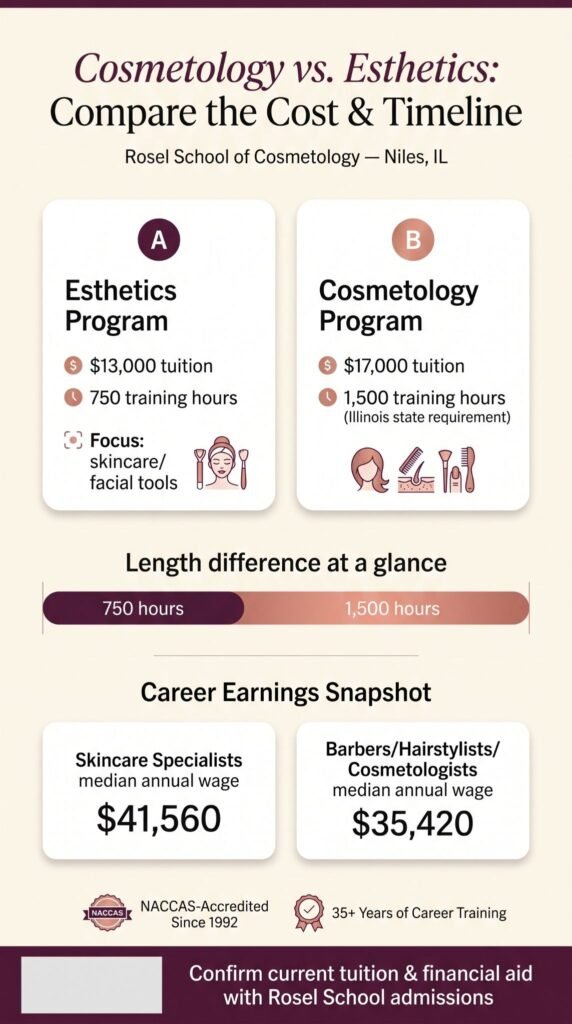
Cosmetology vs. Esthetics at a Glance: Price and Program Length
| Factor | Esthetics Program | Cosmetology Program |
| Confirmed Tuition | $11,000 | $15,000 |
| Program Length | 750 hours | 1,500 hours (Illinois state requirement) |
| Financial Aid / Payment Eligibility | Not yet confirmed: verify with admissions | Not yet confirmed: verify with admissions |
Esthetics tuition is confirmed at $11,000 for 750 hours of training, while Rosel lists its cosmetology program at $15,000 for 1,500 hours. Students should confirm the current total cost and any applicable fees with admissions before enrolling.
Neither program is a lesser choice. The difference reflects their different training scopes, and both lead to professional licensure in Illinois.
Why Financial Aid Status Isn’t Listed Here Yet
Financial aid and payment eligibility can vary by program and change from one enrollment period to the next, so instead of guessing, confirm current financial aid and payment plan eligibility directly with Rosel’s admissions team before enrolling in either program.
Generally, federal financial aid eligibility is governed by federal criteria, including enrollment status and citizenship or eligible-noncitizen status, according to the U.S. Department of Education’s Federal Student Aid eligibility guidance.
Rosel School of Cosmetology offers FAFSA financial aid and scholarships to qualifying students. Students should contact admissions to confirm their individual eligibility and available options.
1. Program Length and Licensing Hours: Why the Cost Gap Exists
The difference in training hours between the two programs is not arbitrary. It reflects their different state licensing requirements.
Illinois requires cosmetology students to complete 1,500 clock hours of instruction before they are eligible to sit for the state cosmetology licensing exam, according to the Illinois Department of Financial and Professional Regulation.
Esthetics is licensed separately under the same department, and Rosel’s Esthetics Program is structured as a 750-hour course, according to IDFPR’s esthetician licensing information, roughly half the training hours of cosmetology.
More required hours mean more instructional time, more materials, and a longer path to exam day, which helps explain the difference in training length between the two programs.
It reflects the different scope of skills each license covers: cosmetology spans hair, skin, and nails, while esthetics focuses specifically on skincare and spa treatments.
2. Paying for Cosmetology or Esthetics Training: What’s Confirmed and What to Ask
What can be confirmed today is this: Esthetics tuition is $11,000, while Rosel lists its cosmetology tuition at $15,000. Students should confirm current pricing, applicable fees, and financial aid eligibility directly with admissions.
Rosel School of Cosmetology offers options such as monthly payment plans and scholarships that may apply to either program.
If you are weighing the cost of either program, ask admissions directly about current tuition, available payment plans, and financial aid eligibility for the specific program you are considering, since figures can differ from one enrollment period to the next.
Getting these answers in writing before you enroll can help prevent surprises later. It also lets you compare both programs using confirmed figures rather than estimates.
Cost-to-Career ROI: What Each Program Can Lead To
Tuition and hours for cosmetology school only tell part of the story. The more useful question is what each investment can lead to after graduation.
The median annual wage for skincare specialists, the occupational category that includes estheticians, is reported at $41,560, or about $19.98 per hour, as reflected in the U.S. Bureau of Labor Statistics 2025 update to the Occupational Outlook Handbook for skincare specialists.
Barbers, hairstylists, and cosmetologists have a reported median annual wage of $35,420, with overall employment projected to grow 5 percent from 2024 to 2034, according to the Bureau of Labor Statistics Occupational Outlook Handbook for barbers, hairstylists, and cosmetologists.
Additional wage detail across percentiles for this occupation is available in the Bureau of Labor Statistics Occupational Employment and Wage Statistics report.
Comparing these figures with each program’s training length gives you more context than tuition alone. A shorter licensing path may allow you to start earning sooner, while a longer path can qualify you for a broader range of services under one license.
For example, a student who wants to enter the workforce quickly may prefer the 750-hour esthetics path. A student who wants the widest possible service menu, including hair and nails alongside skincare, may view the additional cosmetology hours as an investment in future career flexibility.
Time-to-License vs. Time-to-Income
Because esthetics requires fewer training hours, a full-time student can generally reach the licensing exam sooner than a cosmetology student. This may allow them to begin paid work earlier.
A cosmetology student trades a longer training period for a license that covers a wider range of services, which can support a broader range of job opportunities once licensed.
How Rosel School of Cosmetology Approaches Cosmetology and Esthetics Training
Whichever program you choose, you are training at a school with an established accreditation record.
Rosel School of Cosmetology has held accreditation from the National Accrediting Commission of Career Arts and Sciences (NACCAS) since 1992, reflecting its long-standing accreditation history.
This long-standing accreditation is relevant no matter which program you are considering. It reflects the school’s ability to support students through training and toward program completion and licensure eligibility.
Which Program Fits Your Goals?
If you want a shorter path to a license and a focused specialty in skincare and spa treatments, esthetics may fit your timeline and budget better. If you want a broader scope that covers hair, skin, and nails and are prepared for a longer training period, cosmetology may be the better fit.
A student aiming to work in a spa or skincare-focused setting as quickly as possible may lean toward esthetics, while a student who wants to eventually work across multiple services or open a full-service salon career may lean toward cosmetology.
Neither path is the stronger choice in general; the right one depends on the career you want to build and how soon you want to start building it. Before you decide, request the current, confirmed tuition and financial aid details for the specific program you are considering.
Frequently Asked Questions
Q1. How much is cosmetology school at Rosel School of Cosmetology?
Rosel School of Cosmetology currently lists its cosmetology program tuition at $15,000. Students should contact admissions to confirm the current total cost and any applicable fees. The confirmed Esthetics Program tuition is $11,000 for 750 hours.
Q2. Is esthetics school cheaper than cosmetology school?
Esthetics tuition at Rosel is listed at $11,000 for 750 hours, while the cosmetology program is listed at $15,000 for 1,500 hours. The two programs therefore have different tuition costs as well as different training-hour requirements.
Q3. How many training hours does cosmetology school require in Illinois?
Illinois requires 1,500 clock hours of cosmetology instruction before a student is eligible to sit for the state licensing exam, according to the Illinois Department of Financial and Professional Regulation. Esthetics requires 750 hours under the same department’s licensing rules.
Q4. Does financial aid cover cosmetology or esthetics training at Rosel?
General federal financial aid eligibility criteria are set by the U.S. Department of Education, but whether a specific program currently qualifies should be confirmed directly with Rosel’s admissions team, since eligibility and payment plan options can vary by program and enrollment period.
Q5. Which program has a better return on investment, cosmetology or esthetics?
It depends on your goals. Esthetics has a shorter, 750-hour path that may allow you to start earning sooner. Cosmetology requires 1,500 hours but leads to a broader license covering hair, skin, and nails.
Conclusion
Choosing between cosmetology and esthetics comes down to your career goals, training timeline, and budget. Esthetics offers a focused 750-hour path with tuition listed at $11,000, while cosmetology requires 1,500 hours and is listed at $15,000, with broader training across hair, skin, and nails.
If you’re wondering how much cosmetology school is and want to compare confirmed tuition, program length, and financial aid options, contact Rosel School of Cosmetology for current, program-specific details.
The admissions team can help you compare cosmetology and esthetics based on your budget, career goals, and preferred training timeline.