Choosing a nail technician school in Chicago involves more than comparing program lengths or class schedules. Prospective students often search for cosmetology for nails or a nail technician school in Chicago without knowing which factors separate a strong program from a weak one.
This article breaks down the criteria that matter most when evaluating nail technician schools near Chicago, so you can make a confident, informed decision before enrolling.
Rather than ranking schools by name, this article gives you a framework to evaluate any program on its own merits, including programs you find through your own search, whether you are comparing a single nail technician school in Chicago or several programs across the metro area.
Why Choosing the Right Nail Technician School Matters
Enrolling in the wrong nail technician program can cost more than tuition.
If a nail technician school in Chicago is not properly accredited or state-approved, graduates may struggle to sit for the Illinois nail technician licensing exam, may be ineligible for certain financial aid programs, or may find their training hours are not recognized by the state.
This is especially true for anyone specifically researching cosmetology for nails, since nail technology sits within the broader cosmetology field but follows its own separate licensing track.
Because nail technology is a licensed profession in Illinois, the school you choose directly affects whether you can legally practice after graduation. That is why evaluating a program should go beyond location and price.
The right nail technician school gives you a clear, verifiable path from enrollment to licensure and from licensure to a stable position in a salon, spa, or your own business. Taking the time upfront to check these details protects both your tuition investment and your timeline to licensure.
Verify the School Is Accredited and State-Approved
1. NACCAS Accreditation
Accreditation from the National Accrediting Commission of Career Arts and Sciences (NACCAS) signals that a career school meets defined standards for curriculum, facilities, and student outcomes.
NACCAS accreditation can affect federal financial aid eligibility and provides an independently verifiable accreditation standard.
Before enrolling anywhere, use the NACCAS Accredited School Search to confirm a school’s accreditation status directly, rather than relying on a school’s own website claim.
2. Illinois IDFPR Approval and Licensing Hours
Illinois law requires nail technician candidates to complete 350 clock hours of instruction at a school licensed by the Illinois Department of Financial and Professional Regulation before they are eligible to sit for the state licensing exam.
This exact hour requirement is confirmed directly in the department’s official Nail Technician qualifications for licensure. Confirm that the hours a school advertises match this state minimum and that the school itself holds current IDFPR approval, not just a general business license.
A program that falls short of the required hours cannot prepare you for the exam, no matter how strong its marketing looks.
Check Graduation Rates and Program Completion Data
A school’s graduation rate tells you how many students who start the program actually finish it, making it a useful indicator when evaluating a program beyond enrollment numbers or facility photos.
When you contact a nail technician school, ask directly for its current completion rate and how that rate is calculated. Be cautious of schools that cannot produce this figure or that only speak in general terms about student success.
A transparent school should be willing to share its completion data along with its accreditation status, giving you more information to evaluate the program and its outcomes.
Completion data, combined with accreditation and state approval, gives you a much clearer picture of whether a program will actually get you to licensure.
A Decision Checklist for Comparing Nail Technician Schools in Chicago
Most school websites describe their own program for cosmetology for nails in isolation: hours, schedule, and tuition. Very few give you a way to compare that program against any other option you are considering.
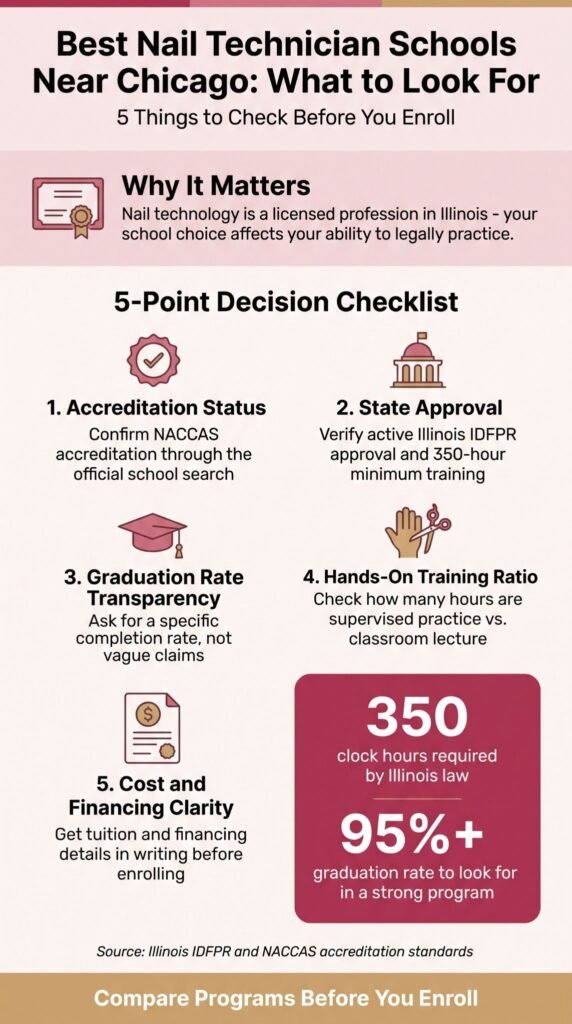
Use this checklist to evaluate any nail technician school near Chicago, whether or not it appears in your search results:
- Accreditation status: Is the school listed in the NACCAS Accredited School Search, and is that accreditation current?
- State approval: Does the school hold active approval from the Illinois Department of Financial and Professional Regulation, and does its program meet the 350-hour minimum?
- Graduation rate transparency: Will the school provide a specific completion rate, or only vague claims of success?
- Hands-on training ratio: How many of the required hours are spent on supervised, hands-on practice versus classroom lecture?
- Cost and financing clarity: Does the school provide a clear tuition figure and financing or payment plan options in writing before you enroll?
Walking through these five points with every school on your list, rather than judging by website design or location alone, is one of the most useful step you can take before choosing where to train.
How Rosel School of Cosmetology Approaches Nail Technician Training
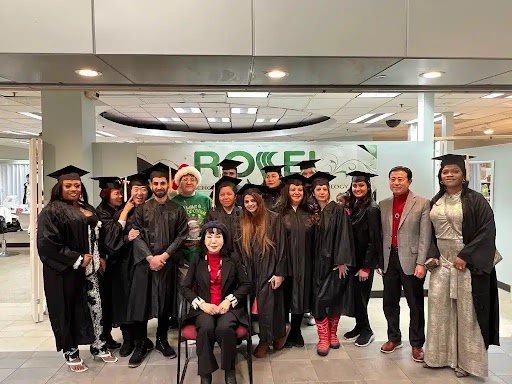
Rosel School of Cosmetology has offered career beauty education in Niles, Illinois since 1989, and its Nail Technology Program provides focused training for students pursuing nail technician licensure in Illinois. It’s the best nail technician school in Chicago.
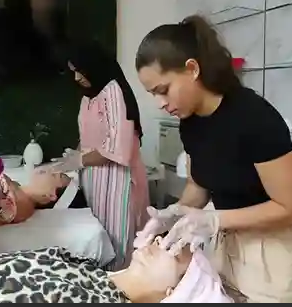
Training takes place in a hands-on salon and spa environment, giving students supervised practice with real client services rather than classroom demonstrations alone.
The program is designed to prepare students for the skills tested on the Illinois nail technician licensing exam, with instruction covering manicuring, pedicuring, nail enhancement techniques, and the sanitation standards required for professional practice.
For prospective students weighing the checklist above, accreditation, state approval, training structure, and licensing alignment are useful factors to consider when evaluating a program.
1. Evaluate Cost, Financing, and Program Length Honestly
Tuition and financing details vary by program and by school, so ask for exact figures in writing rather than relying on advertised starting prices.
National wage data from the U.S. Bureau of Labor Statistics provides wage data for manicurists and pedicurists across different locations and employment settings, which is one more reason to treat training cost as an investment tied to a verifiable outcome rather than a one-time expense.
Confirm whether a program’s cost includes kits, materials, and exam fees, or whether those are billed separately.
Ask specifically whether federal financial aid applies to the program you are considering, since eligibility can differ between a school’s own programs and should never be assumed to be the same across every offering.
Ask whether the school you are considering, especially if it is a nail technician school in Chicago that also offers other beauty programs, applies financing options uniformly or differently by program.
If a school offers payment plans or scholarships, ask how those options apply to the specific program length and cost you are being quoted.
A school that answers these questions clearly, with figures specific to the program you are asking about, is giving you the information you need to budget accurately before you commit.
FAQs
Q1. What accreditation should a nail technician school in Chicago have?
Look for accreditation from the National Accrediting Commission of Career Arts and Sciences (NACCAS), which you can verify directly through the NACCAS Accredited School Search.
NACCAS accreditation can affect federal financial aid eligibility and provides an independently verifiable accreditation standard.
Q2. How many training hours does Illinois require to become a licensed nail technician?
Illinois requires 350 clock hours of instruction at a school licensed by the Illinois Department of Financial and Professional Regulation before a candidate is eligible to sit for the state licensing exam, per the IDFPR’s official qualifications for licensure.
Q3. What is cosmetology for nails, and is it different from cosmetology?
Cosmetology for nails, more formally called nail technology, is a specialized branch of cosmetology education focused specifically on manicuring, pedicuring, and nail enhancement. It follows its own separate licensing track in Illinois, distinct from the broader Cosmetology Program.
Q4. Does financial aid apply to nail technician training in Chicago?
Financial aid eligibility can differ between a school’s own programs, so it should never be assumed to be the same across every offering. Ask any school you are considering for its exact, program-specific financial aid and payment plan details in writing before you enroll.
Conclusion
Choosing a nail technician school in Chicago comes down to a short list of verifiable facts: accreditation status, state approval, graduation rate transparency, hands-on training quality, and clear cost information.
Once you have checked a school against these five points, you are in a strong position to compare it against any other program you are considering.
If you want to see how these criteria apply to a specific NACCAS-accredited program, explore Rosel School of Cosmetology‘s Nail Technology Program and speak with the admissions team about its accreditation, licensing hours, training, and program costs.